
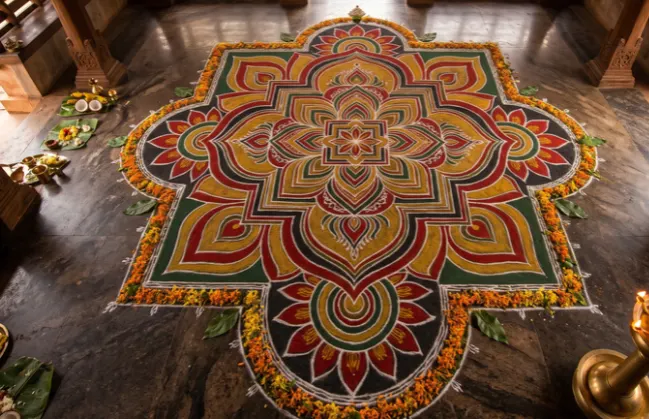
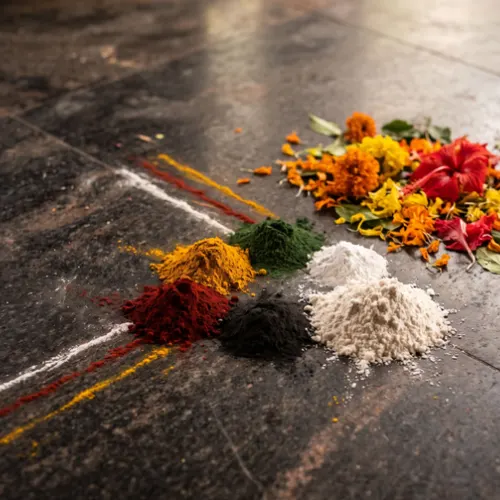
A floor is an unlikely place for a prayer. In Kerala’s ritual art, the ground becomes the canvas. Kalamezhuthu in Kerala refers to elaborate, symbolic designs laid out with colored powders, flowers, and rice flour, made to honor a deity. This guide covers the materials, how the work is organized, the people who make it, and the efforts to pass it on. One clarification first. Roopakkalam, a ground-drawing ritual linked to the deity Vishnumaya in Palakkad, is the example throughout.
Table Of Contents:Roopakkalam is described as a traditional art form where designs are built directly on the ground. They are meant to be elaborate and symbolic, and the stated purpose is devotional. The drawings honor and invoke Vishnumaya.
The roots are described as ancient, from a time when detailed ground drawings served as a way to communicate with the divine. Over the centuries the practice absorbed cultural and regional influences while keeping its spiritual core. It was made as devotion first. The temple’s own material notes that most artwork of earlier eras was religious expression meant to please God.
The sources name three materials: colored powders, flowers, and rice flour, all grouped as natural materials. Powders and flour are loose, so a design made from them rests on the floor rather than on a fixed surface. Flowers bring a different texture to the same drawing.
What the sources leave out is worth stating plainly. They do not list which plants or minerals produce each color, and they do not describe how the powders are applied. Anyone who needs those specifics for research or teaching should ask practitioners directly rather than lean on a general write-up.
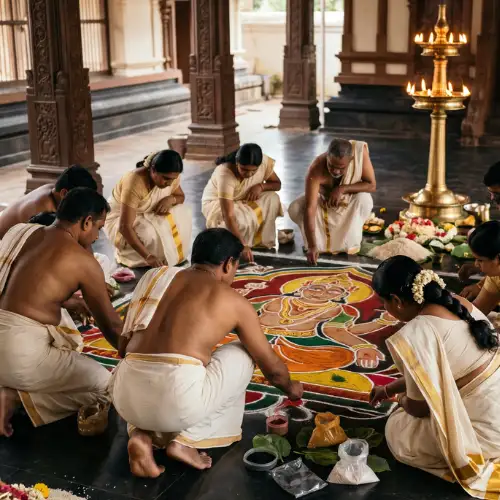
Process here has less to do with a fixed sequence of strokes and more to do with purpose and teamwork. Three documented elements stand out. The design is symbolic, so it carries meaning beyond appearance. It is made as an act of honoring a deity. And at the temple in Thrangali, near Shoranur in Palakkad district, devotees and volunteers build the detailed designs together.
The temple describes that shared work as a source of unity, devotion, and a common spiritual experience. Nobody is described as a lone artist signing a finished piece.
Accounts of Vishnumaya differ in detail. One description from Hindu mythology calls him the son of Shiva and Parvati, remembered for valor and wisdom and for protecting devotees from evil forces. The temple’s own description calls him an incarnation of Shiva and Vishnu. Both framings present him as a protector, which explains why devotees seek his blessings during Roopakkalam rituals.
The temple is described as more than a century old, with its legacy carried on by descendants of its founder, Velayudhan Poojari. Roopakkalam is a highlight of annual festivals such as Vishnumaya Jayanti, alongside special poojas and community gatherings. Prathishta Dinam is another festival, falling in the Malayalam month of Vrischikam under the Atham star, with special poojas led by the temple thanthri.
Festival days can run on a different schedule from ordinary days. Confirm timings with the temple before travelling.
Preservation work is described as ongoing. Workshops, cultural events, and educational programs aim to teach the art and its meaning to younger people, and efforts are underway to involve youth in making the designs themselves. For Kalamezhuthu in Kerala, these programs are the main route the sources describe for keeping the practice alive.
Roopakkalam is a devotional practice, not a service with promised outcomes. Devotees bring a range of personal concerns to the temple, from family conflict to work worries. The temple itself states that these are acts of faith and that results cannot be promised. Anyone facing a medical, legal, or financial problem should seek qualified professional help alongside any religious practice.
Ground drawing in Kerala asks for plain materials and a lot of shared effort, and its meaning sits in devotion more than in the finished pattern. The documented facts are modest: colored powders, flowers and rice flour, symbolic designs, a community of makers and active teaching programs. The details above come from material published by Kalarikkal Sri Vishnumaya Chathan Swami Temple, and readers who want finer points of method should speak with practitioners directly. Which part of this tradition would you most like to see documented in more depth?
Picture a prayer drawn on the floor. Artists build detailed, symbolic designs using colored powders, flowers, and rice flour to honor a deity. The temple sources behind this article call their version Roopakkalam, so I’m sticking with that example rather than guessing about other styles.
Colored powders, flowers, and rice flour. That’s the documented list, and all three count as natural materials. What the sources don’t tell us is which plants or minerals make each color. For that detail, you’d want to ask someone who practices the art.
At the Palakkad temple we’ve been discussing, it’s a team job. Devotees and volunteers come together to build the designs, and the temple says that shared work builds unity and devotion. So it’s less about one star artist and more about a community showing up.
Mostly through workshops, cultural events, and educational programs. The goal is to teach younger people both the art and the reason behind it. Getting young people to help make the designs themselves is part of the plan, according to the temple’s published material.
No. The temple says these are acts of faith, and results can’t be promised. If you’re dealing with something serious like health, money, or a legal issue, talk to a qualified professional too. Treat the ritual as devotion, not a guarantee.
Kalarikkal Vishnumaya Chathan Temple in Kerala, founded by astrologer Kalarikkal Velayudhan, attracts devotees worldwide for blessings and prosperity.
© . Kalarikkal Sri Vishnumaya Temple. All Rights Reserved. | Powered by SilverHost
© 2025 Kalarikkal Shri Vishnumaya Temple
All Rights Reserved | Powered by SilverHost