Delayed marriages. Money that never quite settles. Health worries that keep circling back. When an elder in a Hindu household links such patterns to the departed generations, the word that comes up is pitru dosham. This guide explains what the term means, how ancestral beliefs frame it, and what traditional pariharam usually involves, with no promises about outcomes.
Table Of Contents:In Hindu tradition, pitru dosham is the belief that unfinished duties toward departed forebears can cast a shadow on the lives of their descendants. “Pitru” means ancestors. “Dosham” means a flaw or affliction. It is a cultural and religious idea, not a medical or legal diagnosis, and families use it as a way to talk about trouble that keeps returning.
Ancestral beliefs differ by region and even by household. What one family in Palakkad observes may look unfamiliar to a family in another state. So the first conversation usually happens with a family elder or a trusted priest, not with a stranger online.
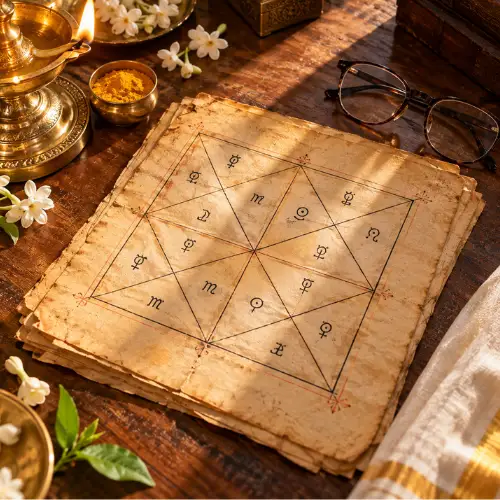
Astrology tends to come next. Many families begin their search for solutions for bad luck with the birth chart, because the exact time of birth fixes the planetary positions that tradition reads as favorable or unfavorable. “Grahadhosham” is the term for the malefic effect of those positions in a star reading, and the same guidance says it can show up as financial strain, health issues, or relationship troubles.
Ancestral dosham and grahadhosham are separate ideas. Some families consult both readings when they feel stuck, yet one does not prove the other. Neither replaces a doctor, a counsellor or a financial professional.
Families who raise the question usually describe trouble in the same three areas: money, health, and relationships. Those are also ordinary parts of life with ordinary causes. A rise in expenses may simply be a budgeting problem, and a lingering ailment needs a clinician, not a ritual.
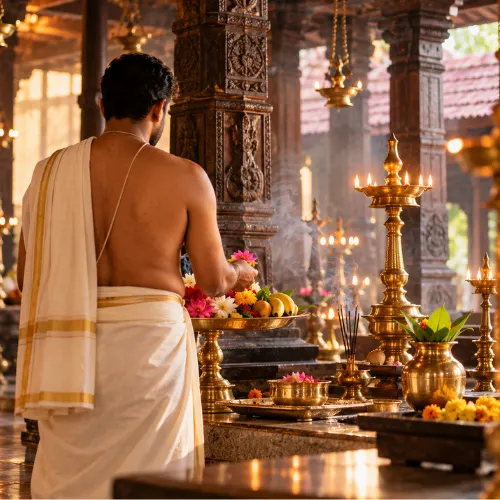
“Pariharam” simply means “remedy”. In temple practice it is a ritual carried out by priests on behalf of a devotee, and the sequence is fairly consistent. The devotee first takes a ritual bath and puts on clean, traditional clothes. Priests then invoke the deity through chanting and prayer. Flowers, fruits, and other sacred items are offered, followed by quiet prayer and meditation. The ritual closes with the priests giving their blessings.
Many temples, like the Sri Vishnumaya Chathan temple, describe their prayers for problems linked to birthtime and grahadhosham. It also calls its special poojas personalized: priests first understand the person’s situation, then shape the ritual around it. Nine are listed, among them nithya pooja, guruthy kalasam, kaivisham removal and chuttuvilakku niramala.
One honest limit. These poojas refer to negative influences and grahadhosham, not to ancestral rites in particular. A family wondering about ancestors should ask the priest directly which rite, if any, fits their custom.
The temple has a history of more than ten decades. Sri Velayudhan Poojari established the worship on the banks of the Nila, and his descendants still carry the rituals forward. The temple states that devotees of every caste, creed, and religion are welcome and that the daily pooja begins at 5 AM.
Devotees describe a sense of peace and relief after special poojas. That is personal experience, and personal experience is not proof that a ritual changes events. No pooja can promise a marriage, an income, or recovery from illness. What a ritual offers is a defined space for prayer, and the meaning people take from it is theirs to judge. Anyone facing a serious health, legal, or money problem should speak to a qualified professional alongside any religious practice.
This dosham sits where belief, family memory, and astrology meet. Understanding it starts with asking your elders what your family has always done for its ancestors, and then, if you want guidance, speaking with a priest who can explain the rites without hurry or pressure. The practices described here come from the documented traditions of Sri Vishnumaya in Palakkad.
Which ancestral custom did your family follow growing up, and does anyone still remember why?
Think of it as a belief, not a diagnosis. Hindu tradition holds that unfinished duties toward departed forebears can shadow a family’s life. Customs shift between regions and households, so your elders are the best first source.
No, they are separate ideas. Grahadhosham comes from planetary positions at your birthtime, while the ancestral idea concerns duties to forebears. Some families look at both, but neither one proves the other.
Expect a ritual bath, clean traditional clothes, chanting by priests, offerings of flowers and fruits, quiet prayer, and a closing blessing. Details change with the temple and the ritual, so ask the priest to walk you through it beforehand.
Honestly, no. Devotees often say they feel peace and relief afterwards, but that is personal experience. For health, money, or legal trouble, see a qualified professional and treat any ritual as an addition, never a replacement.
Regular pooja begins at five in the morning. During major festival dates, arriving earlier is worth considering since crowds build quickly around the main rituals, particularly during Kumbha Bharani.
Kalarikkal Vishnumaya Chathan Temple in Kerala, founded by astrologer Kalarikkal Velayudhan, attracts devotees worldwide for blessings and prosperity.
© . Kalarikkal Sri Vishnumaya Temple. All Rights Reserved. | Powered by SilverHost
© 2025 Kalarikkal Shri Vishnumaya Temple
All Rights Reserved | Powered by SilverHost